
BUILDING a ship that will successfully travel across the void and safely land on another body in our vast universe is not the only consideration that should be given the problems of interplanetary travel—when this new dream of scientists is finally realized. It might be well to give some thought to our method of approach and our plan of action, if and when we succeed in reaching another planet—if there should perchance be life and intelligence where we land. Our well-known author gives us in this new amazing story some very vital things to think about.
MY DEAR NEPHEW ARTHUR:
I am writing to you tonight under considerable stress of mind and I fear, indeed, that this letter will cause you to consider my mentality a little disordered. But I beg of you at the start to cast aside that thought and to read seriously what I have to tell you. A little incoherence is perhaps to be forgiven a man who writes under such a menacing shadow of death as now hangs over me.
I can see you asking yourself in surprise, “Death from what?” I wish I knew the answer to that question myself, but I do not. All I know is that across my path has come a sinister force or forces which I fear may even this very night bring about my—. . . but there, I will leave all this and tell you the facts.
You will remember, no doubt, that in the last ten months I have been engaged in all the time I could spare from my routine work in the School’s laboratories and lecture-halls, in a private research of my own, a study of rocket-fuels and a search for a fuel more efficient than any now available. As you know, I was interested in this field by Henri Mertaud, the late French rocket-experimenter, whom I met more than a year ago in Paris, when attending the International Chemical Convention.
M. Mertaud was kind enough to show me and Dr. Cyrus Hungerford, through whom I met him, some of his model and larger experimental rockets. He rather surprised me by the completeness of his laboratory, which included what he said was the best vacuum-tank for rocket-tests in the world. He gave me an interesting account of the work he had carried on in this field for six years, first in collaboration with Dr. Richard Braun of Berlin, and after Dr. Braun’s death, alone. Mertaud and Dr. Braun, as you know, sent atmospheric rockets much higher in the stratosphere than any had ever done before, having greatly improved the designs of such pioneers as van Hijnn and Morrow.
M. Mertaud was convinced, he told me, that rockets of his design or improvements of his design might with sufficiently powerful fuel attain a high enough velocity to escape entirely from the earth’s attraction and travel through space to the moon or even, at the right time, to the planets of Mars or Venus. He even visualized the possibility of such rockets someday carrying human passengers and being capable of returning to earth. All this development would logically follow, Mertaud believed, upon the improvement of rocket-designs and the invention of lighter and more powerful fuels.
I was so interested by M. Mertaud’s statements that I told him I would not mind spending some time in the study of rocket-fuels myself. Mertaud at once took up the suggestion, as he had understood from Dr. Hungerford that I was a chemist of standing, and the next day sent me a mass of literature on rocket-designs and fuels. In the days that followed, I had several talks with him on the problem, and when I left France, I assured M. Mertaud that as soon as I finished some special work on hand, I would devote myself to the rocket-fuel question.
I did so, a few months after my return, and eventually came to use most of my spare time on the problem. I soon found that the crux of the matter was to combine in a single fuel the necessary elements of lightness, power and quickness of firing. I will not give you the details of my work, but it is sufficient to say that I soon became convinced, as Mertaud and Braun had become, that powders were an unsatisfactory form for rocket-fuels, and that liquefied gases offered a better approach than did ordinary liquid fuels. I was experimenting with combinations of liquid hydrogen with various other liquefied gases, when the news of M. Mertaud’s unfortunate death reached me four months ago.
You may remember that Mertaud’s laboratory burned down and that his charred body was found in it, he having been apparently trapped by the fire. It was supposed that some of the super-inflammable fuels he was testing in model rockets had taken fire, for it was recalled that his former collaborator in rocket-experments, Dr. Richard Braun, had perished in a laboratory-fire of similar nature.
Of course I was shocked by Mertaud’s death, but it did not make me think of giving up my researches, as I had now become quite interested in the fuel problem. I had no thought whatever that his death was anything but the accident it appeared. But I will say at this point that I am now quite certain that the deaths of Henri Mertaud and of Dr. Richard Braun were not accidental. You will understand shortly how I know this.
At the time, though, my only reaction was a sincere regret for M. Mertaud’s unfortunate end, and I went steadily on with my rocket-fuel experiments. I cannot give all the details of my work except to say that in time I came to the conclusion that as a fuel-base, liquid hydrogen had drawbacks that outweighed its advantages, and I began to make tests of various combinations of liquid oxygen, alcohol and other substances.
Not long after this—about two months ago—I entered into some correspondence with an American physicist who had taken up the problem of space-rocket design. This scientist, a Dr. Harris Winn of Detroit Scientific College, was interested in the possibility of designing small space-rockets capable of reaching the moon, and wrote me asking about some features of Mertaud’s work. I answered, mentioning my study of rocket-fuels, and we continued to exchange letters on the subject.
TWO weeks ago I published, in the May number of the Journal of the Association for the Promotion of Science, a short article summarizing the present status of space-rocket work, and mentioning, besides the earlier work of Braun and Mertaud and others, my own work with rocket-fuels and Dr. Winn’s experiments. This was the first public announcement of my work, and you will soon see what consequences it brought in its wake. I fear, indeed, that its final consequence may be my death. But I am again, in my nervousness, outrunning my story, and must put things in their proper order.
Tonight, at about ten o’clock, five hours ago from the time I write this, I had a caller. As you know, I still live and have my private laboratory in the old Melford mansion and estate near the School, with only Barnett, my house-man, staying in the place here at night with me. I was in my study when I heard the bell ring, and in a moment Barnett brought in to me a card bearing the entirely unfamiliar name of “Mr. Peter Nebo.” I told Barnett to show him in. Mr. Peter Nebo proved a rather unusual-looking caller, a squat, stocky man dressed in good-quality clothes that fitted him rather badly. His black hair was close-cut and his face and hands were remarkably white and bloodless-looking, as though the man were just out of long confinement. He had unprepossessing pale-green eyes.
As this Peter Nebo entered the room, I rose to meet him. But Mannie, my little rat-terrier, who had been drowsing by my desk, sprang up before me and ran at my caller, barking furiously and showing his teeth in a diminutive snarl. I had Barnett take out the little dog, then showed Mr. Nebo a chair, and when he was seated, asked what I could do for him.
His pale-green eyes looked at me for a moment with a peculiar weighing expression before he spoke.
His voice was deep bass, unusually resonant, and he spoke in quite unaccented English.
“Dr. Melford,” he said, “I’ve come on rather a strange errand, which has to do with your article on space-rocket work published recently in the magazine of the Association for the Promotion of Science.”
“You’re not a reporter getting a story on the topic, are you?” I asked. Certainly he did not look like one.
Nebo shook his head. “No, but I and some associates of mine are very much interested in that article. Especially in the part of it where you stated that your work with fuels might materially aid in the launching some day of space-rockets toward other planets. Was that correct?”
“It was, yes,” I told him. “Of course, all this work of mine is purely experimental, but, if more efficient fuels were devised, they would certainly advance tremendously the possibilities for successful space-rockets.”
“And it is for fuels of such efficiency that you are searching?” pressed Peter Nebo. “I mean, you are working with the fuel-requirements of space-rockets directly in mind?”
“I am,” I replied, “for such a fuel would have to be highly specialized. But just what is your interest in this, Mr. Nebo? You say you are not a reporter?”
“You will understand my interest,” Nebo answered, “when I tell you that instead of your Association for the Promotion of Science I represent a lesser-known organization that might be called an Association for the Retardation of Science.”
“Association for the Retardation of Science?” I repeated, puzzled. “Is this a joke or am I to understand that. . . .”
“Well, let us say for the retardation of a certain field of science,” Peter Nebo amended. “That field, Dr. Melford, deals with the research of space-rocket improvement, which might someday lead to extra-terrestrial travel and journeys to other planets. Our Association is unalterably opposed to such journeys ever being made by men.”
“But why?” I asked. “Are your objections theological?”
“I am not at liberty to state fully the reasons for our stand,” Nebo said smoothly. “But I will say that we are convinced that man will lose rather than gain by making contacts with other worlds in space, if that is ever possible. We are, in a word, earth-isolationists.”
“That is certainly an unusual viewpoint,” I said. “But I fail to see just what connection this has with my work.”
“The connection is apparent,” said Peter Nebo. “You are, by your own admission, experimenting with fuels that might advance space-rocket design and thus greatly increase the possibility of travel to other worlds. Our society is determined to forestall such travel from ever taking place. We are, therefore, asking you to abandon your researches in this direction and to destroy all the notes and results your work has already yielded you.” For a moment I was too much astounded by the cool effrontery of this request to make answer to it. Then I rose to my feet, indignation possessing me.
“Really, sir, I wonder that you can make such a proposition!” I said. “To ask a scientist to give up his researches because you have some vague objections to them!”
“You refuse to do so?” Nebo asked calmly. Somehow his calmness irritated me the more.
“Of course I refuse!” I exclaimed. “What made you think I would drop ten months’ work at your request?”
The pale-green eyes of the man opposite me hardened as he rose. “It is not exactly a request,” he told me. “It is more in the nature of a demand.”
“A demand?” I cried, and he nodded.
“Yes, and a demand you would do well to heed, Dr. Melford. Our Association is not wholly without power and we are prepared to use force if that is necessary to bring about our wishes.”
“You threaten me, then?” I exclaimed, and Peter Nebo again calmly nodded.
“I do. Unless you quit the rocket-fuel researches immediately of your own will, we will use force to stop them. Will you agree to abandon this work?”
“Mr. Nebo,” I said furiously, “I will give you one minute to leave this house. If you do not, I will call the police. I am only prevented from doing so now by my conviction that you are mentally unbalanced.”
Peter Nebo looked at me for a moment in silence. “I am sorry that this is your answer, Dr. Melford,” he said, and then walked out.
I was so angered for a few moments after he had left, that I was still rather of a mind to summon officers to apprehend the man. But after I had thought it over for a few minutes it seemed to me so evident that the fellow was at least partly insane, that my anger faded into irritation.
I WAS beginning work again on the notes that had engaged my attention before Nebo’s interruption, when from out my subconscious memory came a vague something that startled me. It was a remembrance of something Henri Mertaud had said in the last letter he had written me before his death. As memory of what he had written grew clearer in my mind, I rose to my feet, my thoughts utterly overturned. Then hastening to my file, I began a rapid search in it for Mertaud’s last letter.
When I found the letter, which Mertaud had written to me the day before he perished in his laboratory fire, I ran quickly through it until I found the lines I wanted. I read them through and then, the hazy suspicions in my mind now crystallizing swiftly into a dreadful certainty I went back and read them again.
“This afternoon,” Mertaud had written toward the end of his letter, “another crank called on me, one more original than most of those who bother me. Most of them, you know, are lack-witted people who hear of my space-rocket work and want to set sail with me immediately on a voyage to Neptune or Sirius.
“This individual, an odd-looking, squat, white-faced and green-eyed fellow, coolly told me that he represented an organization opposed to all space-rocket or other scientific work with interplanetary possibilities, and informed me that unless I ceased such work forthwith, it would be the worse for me very soon. I showed him the door without ceremony, as I was rather busy. I remember poor Braun wrote me not long before his death that someone with much the same idea had bothered him. Truly the curse of this work is the number of crazed and insincere persons it attracts to one!”
I stared for moments at those lines, my mind working. That odd-looking white-faced and green-eyed, squat person, who had warned Henri Mertaud, could only be the man I had just ejected, Peter Nebo. Nebo had demanded of Mertaud that he stop space-rocket research. Mertaud had refused, as anyone would—and within twenty-four hours Mertaud had perished! That laboratory fire that destroyed Mertaud and his work, was it accidental? Or was it the work of Nebo and his associates?
And what had Mertaud said ... that Dr. Braun shortly before his death had mentioned someone who had told him to halt his rocket-researches. And Braun, with his work, was destroyed soon after that just as Mertaud was later! Was it Nebo and his associates, then, who had warned and destroyed in Braun’s case also? Then Nebo’s tale of his organization determined to stop space-rocket research at all costs, was the truth, and no mere figment of his mind!
It seemed and still seems to me that any group of men must be partly mad who would let their convictions on such an academic subject carry them to such lengths, but whatever the truth as to that, it was indisputable that these men were deliberately using murder when other means failed to stop all scientific research that might lead to interplanetary travel!
If this was so, I was in real and imminent danger. Nebo and his associates had warned me and I had flouted their warning. If the cases of Braun and Mertaud were any criterion, they would not allow me long to live. Most of my notes and formulas on the rocket-fuel experiments were in my private laboratory here in the house, as no doubt they knew. At any time they might try to destroy me and my work together as they had destroyed Braun and Mertaud.
Immediately I reached for the telephone and in a minute I had laid the situation before the police department. Though somewhat skeptical at first, my account of the deaths of Braun and Mertaud, and of Nebo’s presumed connection with them, changed their attitude, and they agreed that it. was imperative that my house have protection for at least the next few nights.
So a little less than two hours ago there arrived one Police-Captain Crail with four officers. To Captain Crail I recounted the whole matter and he agreed that it was possible Nebo and his associates might try to fire the house to destroy me and my work, as they had apparently done with the German and French rocket experimenters.
Captain Crail suggested that he and his men take up positions of hiding in the shrubbery around the house and grounds, and thus be able to apprehend Nebo and his companions if they approached the house. I agreed to the wisdom of this course and had Barnett show them to suitable places of hiding. I then returned to my study, only a little easier in mind.
THAT, as I say, was less than two hours ago. Crail and his men have been hiding out there during this time, but apparently no one has approached the house. At Crail’s orders, one of the officers has come into the house each quarter-hour to make sure of my safety. As all this has made me too nervous to sleep or work, I have spent the intervening time in writing to you, my dear Arthur, this account of what has happened. My reason for so doing is that I want you to leave your classes at Manhattan University and come down here to stay with me for the next few days.
I realize that I have no right to draw you into any danger that might threaten me, but I have no one else to turn to. The police will be watching, of course, but that is not like having a companion. You will perhaps feel surprised that I should experience such apprehension over the threats of this group of men, but this Nebo made so strong an impression on me, and the record of the two space-rocket experimenters dying shortly after his warnings is so close and sinister, that I cannot rid my mind of a certain foreboding.
Barnett is waiting now to take this letter out to mail, and Captain Crail’s man has just come in again to see that we are all right. It is within a few hours of morning and I will be a great deal relieved, and perhaps less fearful, when day comes. But in the meantime, Arthur, I confess that you will make me feel much better, if on receiving this letter, you will wire me that you are coming.
Your affectionate uncle,
FERDINAND MELFORD.
PROFESSOR VON GERSTEN, having asked me to draw up for our own consultation, an account of events from the time I received my uncle’s letter until now, I am doing so with the aid of some details from Captain Crail and Lloyd, my close friend and superior at Manhattan University, Dr. Lloyd Jackson. I am afraid that this precis will hardly serve to explain the dark mystery that enmeshes us, and that seems to grow darker and more terrible with the passing of time, but it may help.
Ten days ago I was living the more or less carefree life of a physics instructor in the New York institution where I’ve held a post for the last three years. My chief concerns were the dinning into a couple of hundred thick-headed sophomores the elementary facts of electricity and magnetism, and the equally tough and fruitless struggle to bring my golf score under a hundred. Then came my uncle’s letter and swift-following on its heels—tragedy.
I received the letter of my uncle, Dr. Ferdinand Melford, early on the morning of June 2nd. I found it in my mail when I arrived that morning at Manhattan University for an early final-exam I was giving. As letters from uncle were rather infrequent, though our relations were of the friendliest, I opened and read it at once.
I was astounded! My uncle’s account of the threats made against him by this Peter Nebo, whoever he might be and of the strange deaths of the other two space-rocket experimenters, Braun and Mertaud, was startling. I did not wonder that uncle feared a like fate at the hands of Nebo and his group, whatever their motives. And when I showed the letter to my superior, Lloyd agreed with me that a real danger threatened Dr. Melford.
I was touched by my uncle’s half-apologetic request that I stay with him for a few days. Certainly no one had a better right to make such a request, for Uncle Ferdinand had taken the place of my dead parents in my boyhood and youth, had supervised my education and guided my choice of a career. More a father than an uncle, in my regard, I did not hesitate a moment in arranging to have a substitute give my classes their examinations for the next few days.
But before I left the university that morning, the tragedy came. It arrived in the form of a telegram for me, which I reproduce herewith.
Dr. Ferdinand Melford and servant killed shortly before morning in fire that destroyed house.
Please come to Philadelphia immediately.
Crail, Police Department.
An hour later I was on a train speeding southward through the familiar New Jersey cities. And Lloyd was with me.
My dominating emotion was keen grief for my uncle. I had never realized how much the kindly, elderly scientist meant to me until I received that telegram. But before our train reached Philadelphia, I had set aside for the time my emotion, and was discussing with Lloyd the most important fact—the certainty that Dr. Melford had been murdered.
It was clear enough, in view of his letter of the night before. Nebo and his associates had carried out their threat and uncle and his laboratory had been destroyed just as had Mertaud and Braun. It seemed incredible that men could live who would commit a string of murders simply because of their objection to such an abstract field of science as space-rocket research.
It was indisputable that that had been the cause of uncle’s death, though. There remained the question as to how he had met death while supposedly under police protection. I meant to investigate that problem, too.
WHEN Lloyd and I debarked at the Broad Street Station that afternoon, we took a taxi and drove south-westward across the city to the suburb in which lies the Philadelphia School of Science. Not far from the campus the cab turned into the extensive wooded grounds of the old Melford estate.
The grounds of the old place looked the same, with their big oaks and beeches and dense, rather unkempt shrubbery, as when I had spent my boyhood there. But the rambling old frame mansion that had been the home of several generations of Melfords was reduced to a pile of debris in which several policemen and plain-clothesmen were searching.
One of the latter came over to Lloyd and me as we got out of our cab. He was a keen-faced man of middle age, whose expression had now a certain tenseness and haggardness.
“I’m Captain Crail,” he told me. “You’ll be young Mr. Melford?”
“Yes, and this is Dr. Jackson,” I said. “My uncle’s body. . . .”
“It and the servant’s remains, what there is of them, have been removed to a mortuary,” Captain Crail said.
“What about this Peter Nebo and his associates?” I demanded. “Have you caught them yet?”
Crail shook his head. “No, we haven’t, though we’ve got a net spread for Nebo over this whole end of the country.”
“I understand that you and four of your men were watching the place at the time this happened,” I said.
Captain Crail nodded, his face unhappy. “We were, and that’s what makes me feel worst on the thing. Five of us here to protect Dr. Melford—and he and the servant killed in spite of us.
“But I’m not sure that five hundred men around the house would have saved your uncle. Whoever this Nebo and his pals may be, they fired the place in a way that we can’t even guess yet.
“It happened at three in the morning, less than an hour after your uncle sent that letter to you. I and my four men were hiding in the shrubbery right around the house here, and no one could possibly have gotten within fifty feet of the place without being seen by us.
“To tell the truth, I didn’t really think there was much danger threatening your uncle. From your uncle’s account, I judged this Nebo as just another crank. Who but cranks would want to stop scientists from monkeying with rockets? But the thing was too serious to take chances on, in view of what your uncle told us about the German and French scientists who had been killed, so we were watching.
“I’d told Wilkes, one of my men, to go in every fifteen minutes and make sure your uncle was all right. Not that I had any idea anybody could get through us to the house, but I just didn’t want to take any chances. From where I was hidden, I could see Wilkes go in each time, and about two o’clock I saw Barnett come out and mail the letter your uncle had written to you.
“BARNETT returned in a few minutes and everything was quiet. At three o’clock Wilkes went in as usual on the quarter-hour and he reports your uncle was writing in his study, with his dog beside him, and Barnett was sitting in the hall. Two minutes after Wilkes came out, it happened.
“The house simply exploded into flame! I never saw anything like it—one minute the house was a big darker bulk in the darkness, and the next it was a single sheet of flame roaring upward as though every particle in the place had taken fire at the same instant!
“We ran toward it but to enter that roaring furnace would have been suicide. Your uncle and the servant must have been dead immediately—we never even heard a cry from them. We ran around the grounds looking for anyone who might have started it, but there was no one! Not even a car was in sight, though one of my men, Janney, says he did hear a whirring noise as of a car speeding away.
“The place was burned down to ashes quicker than anything I ever saw before, even before the firemen got here. If it had been soaked in gasoline and filled with gunpowder it couldn’t have burned faster—it was more an explosion of fire than burning.
“I had them get the radio-cars into this district and comb it for signs of Nebo or other suspicious-looking characters, but they found no one. Meanwhile Nebo’s description was sent out to all nearby cities on the teletypes, and that may get us some line on him yet. I sent cables also to the Berlin and Paris police for dope on the Braun and Mertaud deaths, and then wired you the news.”
Captain Crail looked squarely at me. “Now, before anything else, Mr. Melford, I want you to tell me straight, whether you think I and my men were negligent in failing to prevent your uncle’s death.”
I shook my head slowly. “It seems that there is no way in which you could have prevented what happened,” I said. “But what I want to know is, what did happen? How did Nebo’s band fire the place so swiftly, and apparently invisibly?”
Crail spread his hands helplessly. “Mr. Melford, the thing’s as much a mystery to us as it is to you. There seems no way to explain it, for I’ll take oath they weren’t on the grounds.”
“Maybe they dropped an incendiary bomb from a low-flying airplane?” Lloyd suggested. “You said one of your men heard a whirring sound.”
The police-captain shook his head. “They couldn’t have done that, Dr. Jackson. It was the darkest kind of night last night and no plane, even at its slowest speed, could locate a house accurately enough for that. Also, a plane’s motor is unmistakable, and we’d all have heard it. As it was, only Janney thought he heard a low whirring.”
We looked at each other, then at the men still industriously delving in the ashes. The thing was baffling, the more so as I could see no rational motive for it all.
“It seems unbelievable that any men should feel so strongly on the subject of preventing travel to other planets that they’d kill two or three space-rocket experimenters simply to stop research along that line!” I exclaimed. “Nebo and his associates must have some other motive for these killings!”
“I’m not so sure,” Captain Crail replied. “Madmen will do unpredictable things and I believe that Nebo and his companions, however many of them there may be, are all mad.”
“Madmen who all have the same delusion?” I said skeptically. “Madmen who can execute crimes like these?”
“Yet madmen they are in my belief,” Crail persisted. “Madmen whose crazed brains have somehow acquired the idea that for men ever to travel to other worlds would be unholy and forbidden, and who are deliberately murdering all workers on space-rocket and other experimenters who might further interplanetary travel.
“I’ve wired asylums here and abroad asking information on any patients released or escaped in the last ten years with delusions on that subject. I’m expecting an answer from them and also from the Berlin and Paris police on the Braun and Mertaud cases. We might go back into town to headquarters and see what they answer.”
WE agreed to Captain Crail’s suggestion, and after he had ordered his men to continue searching the ashes for possible clues, we drove in with him to the Police Department Building.
In Crail’s little office, two lengthy cablegrams and some shorter messages were awaiting him, and he read them to Lloyd and me.
The cablegrams were from the Berlin and Paris police and gave the details of the deaths of Dr. Richard Braun and of Henri Mertaud. Dr. Braun’s death had occurred two years before. He had a rocket workshop at the edge of a Berlin airport and it had been seen one night to burst suddenly into violent flames, destroying Braun and most of his work. The police-theory had been that some of his rocket-fuels had taken fire or exploded suddenly.
The same theory was held by the Parisian department in regard to Henry Mertaud’s death four months back. Mertaud’s field-laboratory had been outside Paris, but his model and testing-laboratory had been in the heart of Paris, a small two-story brick structure. It, too, had been seen at night to explode abruptly into fire and only the charred remnants of Mertaud’s body had been found in it.
The shorter wires were from various asylums and bureaus replying that they had no record of any patients with delusions as to interplanetary travel having ever been released or escaped.
Captain Crail tossed the messages down upon his desk. “Which advances us not at all,” he said. “We knew Nebo and his band killed Braun and Mertaud, and now we’re sure they did it in the same way that they fired Dr. Melford’s place, but that’s all.”
“No reports of Nebo’s presence have come in from neighboring cities?” Lloyd asked, and Crail shook his head.
“Not one. You’d think the man had vanished into thin air, and until we get him, we’ve no chance of laying hands on whatever associates he may have.”
We three were staring rather helplessly at each other and night had fallen, when a card was brought in to Captain Crail.
“Professor Herman von Gersten, Berlin,” read Crail. “What does he want?”
“He says it’s about the death of Dr. Melford,” said his assistant, and we all started a little.
“Send him in at once,” Captain Crail directed.
PROFESSOR HERMAN VON GERSTEN proved to be a thick-set man of middle age, with short curly blond hair, eyes, that were as keen as Crail’s, behind his thick-lensed glasses, and a deceptively ingenuous face.
Crail greeted him and briefly introduced Lloyd and me. Von Gersten’s eyes lit when Crail named me.
“So, the nephew of the unfortunate Dr. Melford!” he said. “That is good, that I meet you so soon.”
“I understand you’re here about Dr. Melford’s murder—you’ve got something to tell us?” asked Captain Crail hopefully.
“On the contrary,” answered von Gersten. “I am here investigating that murder, as I have been investigating, when time allowed me, for the last eight years.”
“The last eight years?” Crail repeated. “Why, Dr. Melford was only killed last night.”
“You misunderstand,” the German informed him. “It is not Dr. Melford’s death I have been investigating in these eight years, but the deaths of other men who have died as he died—and for the same reason!”
“You mean Mertaud and Braun?” I put in, and the Teuton turned quickly toward me.
“Ah, so already you know that Dr. Melford’s death and those of Mertaud and Braun are connected?”
“We know, yes,” I said, and would have continued, but Crail intervened.
“Just a moment, professor,” he said. “I’d like first to know if you are an authorized investigator or police-agent.”
For answer von Gersten drew from his breast-pocket a small blue card he handed to Crail with a bow.
“I hold a chair in the Berliner Polytechnik Institut,” he said, “but have also a post in the Criminal Science Department of the Berlin police.”
“Good enough,” Captain Crail remarked as he handed the card back. “And you want us to tell you the details of Dr. Melford’s death?”
“I do, yes,” von Gersten said. “When you have told me, it may be that there are things that I can tell you. A fair exchange of information, not so?” He beamed upon the three of us.
“Well, the facts as to Dr. Melford are soon told,” Captain Crail said gloomily. “If the newspapers had them, instead of thinking the thing accidental, as they do, they’d be headlining it.”
He briefly recounted the facts and von Gersten listened with utmost attention. When Crail had finished, the German’s blue eyes were keen as sword-blades.
“It is as I feared,” he said. “Had I landed in this country yesterday instead of today, I could have saved your uncle.”
“You knew then that an attempt to murder him would be made?” Crail shot at him.
“I knew the possibility of that,” von Gersten amended. “One week ago I read in the excellent Journal of the Association for the Promotion of Science an article by Dr. Melford on space-rocket work, mentioning his work with rocket-fuels and also the space-rocket experiments of a Dr. Winn of Detroit.”
“I saw that article and I went straight and bought a ticket for America on the next boat. I landed in New York today, intending to go to Philadelphia to Dr. Melford. But in the newspaper I read an article describing Dr. Melford’s death in a fire that had his house destroyed. I knew then that they—those whom you call Nebo and his associates—had struck even sooner than I had expected.”
“You were going then to warn Dr. Melford that Nebo and the rest would be after him?” Crail asked.
Von Gersten bowed. “Yes, for I knew that so soon as they learned of the rocket-researches of Dr. Melford and also of Dr. Winn they would act to stop them. And I had a plan as to that.”
“But who is this devil, Nebo?” I interrupted. “You must know that, if you know so much about this.”
The German looked gravely at me. “Yet I do not know that, Mr. Melford. Who is Nebo? How many associates has he? Where is his home or base? I know no more than you.
“But I have followed the work of this man and his companions for eight years, and do know something. I know that Nebo, who has used the names of Smart, Wladolowski, Cametto and others indiscriminately, and his associates, have murdered at least eleven scientific experimenters in these eight years!”
“Eleven!” I exclaimed. “Eleven scientists coldbloodedly wiped out by this madman and his band ?”
“I am not so sure, myself, that he is a madman,” von Gersten said. “But I will tell you briefly of Nebo’s record.
“You have heard of Willem van Hijnn, the Dutch engineer who was the pioneer in space-rocket research. He who sent small rockets higher into the stratosphere than any before him had ever done? Well, van Hijnn died eight years ago, as perhaps you remember. And he died as Dr. Melford died—in a fire that swept his workshop!
“Van Hijnn was a friend of mine, and I was in Amsterdam at his funeral. I suspected nothing, any more than anyone else, until I came across a diary he had left in his bedroom at home. In it, two days before he died, van Hijnn had recorded how a man named Wladolowski, a strange-looking man with unnaturally white face and green eyes, had called on him and warned him he must stop his work with space-rockets. Nebo, of course, under a different name.
“Naturally, van Hijnn had refused—and two days later he was destroyed. That aroused my suspicions. Yet try as I might, I could get no further trace of the so-called Wladolowski. I forgot the occurrence until two years later, when the Englishman, Fexil Morrow, perished. Morrow was a London author who had taken up and gone on with van Hijnn’s space-rocket experiments, because of his intense interest in the possibility of traveling to the moon or to some planet.
“Morrow had a Thames-side workshop with a trained technical assistant and had made a hobby of his space- rocket models. His workshop, too, puffed into flame one night—always at night, mark!—and he and his assistant were burned to death. I read of that and would have thought nothing of it, had not the newspaper mentioned the efforts of the London police to trace an odd- looking, green-eyed man who had had some sort of altercation with Morrow the night before the fire.
“At once I remembered the case of van Hijnn. Was this, then, the man who had had the argument with Morrow, the Wladolowski who had threatened van Hijnn? I went to London to investigate, and I learned that this time the green-eyed man had given his name as Smart. After leaving Morrow’s place, he had been seen to join three companions a little along the street.
“This meant that my Wladolowski or Smart was not working alone but had associates. How many of them he had, or has, I cannot guess. By that time I was convinced that Morrow and his assistant were murdered to stop them from continuing their space-rocket research, just as van Hijnn had been. This must mean a group of madmen was at large, so strongly infected with the delusion that space-travel was unholy that they would kill to prevent it from ever being brought about.
“The next space-rocket experimenter to meet death was Krasny of Buda-Pesth, eight months later. Then over a year afterward, two Japanese scientists who had advanced a scheme for firing a projectile to another world from a huge cannon sunk into the earth’s crust, were slain in their Tokio laboratory. In both cases, that of Krasny and of Oyumi and Shota, a visit from a caller easily identifiable as your Nebo or my Wladolowski had preceded their deaths, and in both cases the experimenters perished by fire.
“In the years since then, six more scientists were destroyed. Dr. William Hayes, the Australian scientist who was at work on a new kind of successive-firing rocket, was next. As usual, his death was by fire, though in his case I could not trace any call by Nebo beforehand. I am sure that such a call took place, however, as these murderers seem punctilious in warning their victims and giving them a chance to stop their research.
“After Hayes, followed the death of Serge Wilsoff, of the Soviet’s Moscow laboratories. Wilsoff had been trying to devise rockets for passenger-traffic over oceans, and had turned to consideration of the launching of one into space. Quickly came the warning
to stop such research. Then, when the warning was disregarded, came death by fire. Very shortly after, L. Molokoff, who took up Wilsoff’s work, met the same fate. And in the last two years have followed the similar deaths of Dr. Braun, of Henri Mertaud and now of Dr. Melford.
“In each case,” von Gersten’s eyes were glittering as he drove home his point—“in each case the murder was done by firing the laboratory, workshop or home of the scientist in question. In my opinion that is done so the man and his work would perish together. In no case was the method of firing discoverable, but every time it happened during the night.
“Also, in each case, the scientist was given a chance to stop his work. Nebo, under one name or another, called on them and warned them that all research leading toward space-travel must halt. All of the eleven disregarded this warning, and all have died.
“I might have been able to save some of them by warning them, but in no case have I had time. For in every instance, the warning and the murder took place almost directly after it had become publicly known that the scientist in question was engaged in space-rocket research. Evidently Nebo and his companions constantly scan scientific journals and newspapers and miss no such news, and evidently they act at once on learning of it.”
Von Gersten leaned back, spread his hands. “There you have the story,” he said simply. “Eleven experimenters slain by this Nebo and his band—a remorseless, relentless group who have determined apparently that space-travel never shall take place. And a group who have eluded all efforts at discovery!”
Crail and Lloyd and I had listened to von Gersten intently and with deepening perplexity.
“By God, it’s unbelievable!” Captain Crail exclaimed. “A bunch of lunatics running down eleven scientists like that!”
“But are they lunatics?” Lloyd asked. “Professor von Gersten, can these men really have no other motive for this list of murders than a common delusion?”
The German shook his head slowly. “Many times I have asked myself that question,” he admitted. “Sometimes it seems to me that only the craziest of lunatics would such murders commit. And at other times I seem to sense behind these crimes some great mystery whose edge we do not even approach.”
“Well, whatever is the motive of Nebo’s group, it’s up to us to catch them,” said Captain Crail. “Have you any idea as to how that could be done?”
Von Gersten’s head bobbed. “I do have an idea, one that brought me to America,” he said. “I meant to try it with Dr. Melford, but it is not too late—we can try it with the Doctor Winn, the other rocket-experimenter Dr. Melford mentioned in his magazine-article.
“My idea was this, that Nebo’s group would sooner or later approach Dr. Melford when they learned of his space-rocket work, and warn him to stop it, as they have always given warning. I meant to persuade Dr. Melford to have men ready at all times with him to seize this Nebo or whatever name he might give, when he came to give his warning.
“It is too late, as I say to carry out that plan with Dr. Melford. But we can do it with Dr. Winn. Sooner or later, Nebo and his associates will warn Dr. Winn as they did Dr. Melford, to stop the space-rocket work. We will get Dr. Winn to keep about him out of sight, policemen who will seize Nebo when he calls upon him!”
“That’s a real idea, professor!’’ exclaimed Captain Crail, his eyes kindling. “I never thought of it, but it’ll give us a real chance of getting Nebo, and once we have him, we can soon get the rest of them!”
“But hadn’t you better communicate with Dr. Winn at once about it?” Lloyd asked. “There’s no telling how soon your Nebo might visit him, now that Dr. Melford is disposed of.”
“That’s right,” Crail said. “I’ll get Dr. Winn on the phone now—once he agrees to the plan we can go up there to Detroit and be waiting with him when Nebo shows up.”
He grasped the telephone and in a few minutes the connection to Detroit had been put through. The Detroit Central reported that Dr. Winn’s home had informed her that the scientist was this night in his laboratory in one of the buildings of Detroit Scientific College, and that she would connect us with him there.
In a few moments more, in fact, a thin and somewhat impatient voice was audible from the receiver Captain Crail held.
“This is Dr. Harris Winn,” it stated. “What is it?”
“Dr. Winn, this is the Philadelphia Police Department, Captain Crail speaking,” said Crail. “You read of Dr. Melford’s death?”
“Yes, yes—a sad accident,” answered Winn. “Melford was a brilliant man. But what are you calling me about?”
“We are certain that Dr. Melford’s death was not an accident,” Crail told him swiftly. “We believe that the murderer, or one of them, may call on you sometime soon and we want to arrange that he be detained if he does so.”
“The murderer of Dr. Melford call on me? Why in the world should he?”
“Dr. Melford was murdered by a group of madmen or fanatics of some sort who are bitterly opposed to all scientific research into space-rockets, which might lead to space travel,” Crail explained. “Their leader, who named himself Peter Nebo, warned Dr. Melford shortly before his murder to stop such research, and we believe Nebo may give you a similar warning.”
“But I’ve already had a warning of that sort—this very afternoon!” replied Dr. Winn.
We jumped to our feet. “You have?” cried Crail. “Who gave it to you—what happened?”
“It was a man who called himself Walter Ennis,” replied Dr. Winn, “a short, stocky person.”
“Did he have an unusually pallid face and green eyes?” cried Crail.
“Yes, that describes him exactly. He told me some fol-de-rol about an organization opposed to space-rocket experimentation and demanded that I stop my researches. I showed him the door.”
“Dr. Winn, that was Peter Nebo—the head of the group that killed Dr. Melford and almost a dozen other scientists in the same line of research!” cried Captain Crail.
“Tell him to at once leave his laboratory; to hide in another part of town!” exclaimed von Gersten, his blue eyes blazing. “He is in most deadly danger!”
“Get out of your laboratory, out of the building!” Crail told the scientist on the other end of the wire. “At any moment Nebo’s group may carry out their threat and destroy you as they did Melford and the rest!” “But I don’t understand . . .” we heard Dr. Winn start
to say when he broke off suddenly. Then from the receiver in his voice came a high scream that mingled with a loud roaring sound. “My God, it’s . . . .”
“What is it?” yelled Crail into the transmitter. “What’s happening?”
The receiver was silent as the grave. Crail jabbed the hook fiercely as von Gersten and Lloyd and I pressed tensely to him. “Operator!” shouted Crail. “What’s the matter with that line?”
“I don’t know; it just went dead,” replied the Detroit operator’s voice. “Just a moment, please, and I’ll find out what’s the matter.”
In a silence of utter suspense we four waited in the little Philadelphia office, our minds all at the Detroit end of the wire. It was not one moment but many before we heard the Detroit operator’s voice again, this time excited.
“Your line went dead in a fire!” she reported. “The building of Detroit Scientific College, in which your connection was, is reported as having burst into flames and is already half-destroyed, they say.”
“What about our party, what about Dr. Winn?” cried Captain Crail.
“There’s a report that there were only two men in the building—a professor and a janitor—and that the fire was so sudden that neither escaped!” the operator answered. “If you’ll hold the line, I’ll get the names for you . . . .”
But Captain Crail set the telephone down on the desk softly and turned to us. His face was very white. “This time too, Professor von Gersten,” he said, “you have been just a little too late. Dr. Winn is dead.”
Von Gersten’s eyes now were cold, steely. “The twelfth man dead at the hands of Nebo’s gang, yes,” he nodded. “And the only chance we had of capturing Nebo—gone!”
BEING a policeman and not a writing man, I didn’t want at all to draw up this recountal of the events in this case that followed the murder of Dr. Winn. But the others, young Melford and Professor von Gersten and Dr. Jackson, having insisted that I was best fitted to do so, I am taking it on. There’ll be no more literary polish in it, though, than in any police report.
I’ll admit that I was rather knocked off my feet on that night of June 2nd when we four in my office heard of the destruction of Dr. Winn and his laboratory in the Detroit College. It had never occurred to me that Nebo and his pals might strike again so quickly after their murder of Dr. Melford, and I felt a certain responsibility for not having warned Dr. Winn.
Also, I still felt responsible more or less for the murder of Dr. Melford. Of course, as Arthur Melford had agreed, Nebo’s band must have used some unheard-of way to fire Dr. Melford’s house, and a hundred policemen around it would apparently have done no more than we did, to prevent it. But just the same, no policeman who is called on for protection, likes to see the man he’s protecting murdered under his nose, and that’s what had happened to Dr. Melford.
It made me determined to get this lunatic Nebo and whatever nuts might be trailing with him, if it took me ten years. That began to look like more of a job when this von Gersten appeared and told us of the number of space-rocket experimenters and scientists that Nebo’s group had killed in the last eight years. But the idea of nabbing him through Dr. Winn brightened things up for me.
The destruction of Dr. Winn, that took place literally within our hearing, though he was in Detroit and we in Philadelphia, blasted our hopes in that direction.
The first news given us by the Detroit operator was soon supplemented by the Detroit police.
According to them, the building at Detroit Scientific College, in which Dr. Winn was, had simply puffed into flame from top to bottom. Winn and the other man in it, the janitor, had no chance to escape.
No cars had been seen leaving the place during or after the fire, and no one had reported seeing a man of the description of Peter Nebo. The Detroit police promised to get a dragnet out for him at my request, but I had small hopes of their success.
When I finished talking to them, I looked at the others. Young Melford and Dr. Jackson were rather white but Professor von Gersten seemed more keenly disappointed than shaken.
“Gone—the chance to catch that demon!” he exclaimed. “Had Dr. Winn known sooner, he could have had men there to seize Nebo when he visited him this afternoon!”
“There’s no use going over what might have been,” I told him. “The thing to do is to get on the trail of Nebo and the rest before they spring any more of these murders.”
Von Gersten shook his head. “My friend, there will be no more murders in the immediate future,” he assured me. “For the simple reason that Melford and Winn were the only outstanding space-rocket experimenters, and that until new experimenters take up the problems of interplanetary travel and attract the attention of these madmen, they will have no cause to act.
“But when we next hear of such scientists taking up space-rocket research, we will not delay. We will surround them with men who can seize whichever of Nebo’s group appears to warn them. And once we have some of them, if only one, we can search out the others.”
“Then that’s what you’re going to do—wait until other scientists take up space-rocket work and use them to trap Nebo?” Arthur Melford asked. Von Gersten nodded.
“It is all that can be done. It may mean a long wait, but sooner or later the chance will come, and then we will maybe end once and for all this organization of mad murderers.”
I stared at the three of them. “Say, you three may be swell scientists, but I’ll say you’d make poor cops!” I said. “To talk about waiting, maybe for years, until some other scientists take up the rocket-research!”
“What else is there to do?” Arthur Melford asked.
“Do?” I repeated. “Didn’t you ever hear of the gentle art of framing? Don’t you suppose that Nebo and his fellow-nuts can be framed as well as any gangster or gunman?”
“Frame Nebo?” said Melford. His face lit up. “I think I see what you mean! You mean to get some scientist to give out that he is seriously engaged in space-rocket experiments, and that that will .. . .”
“Will come to the attention of Nebo and his associates and they’ll think it’s straight,” I finished for them.
“And when they call on the scientist in question to give him their usual polite warning about stopping his experiments, before bumping him off, they’ll run into a bunch of hidden men they won’t have a chance in the world to get away from!”
“It is superb!” cried von Gersten. “Captain Crail, I congratulate you—this will mean their capture!”
“Well, save the congratulations until we’re in the clear,” I told him. “The first thing to do is to fix it up for some scientist to publish a lot of stuff about his important space-rocket experiments. It ought to be a scientist of first-class standing, too, so that Nebo and his gang won’t suspect camouflage.”
“You’ll find it rather hard to get a scientist of standing to put out such a story,” predicted Dr. Jackson. “Scientists are so jealous of their scientific reputations that most of them would refuse to take a chance of impairing their standing by issuing untrue statements.” I grinned at him. “I know that, but I know one scientist of first-rate standing who’ll do it, I think. His name’s Dr. Lloyd Jackson.”
“I?” said Jackson startedly. “You want me to announce I’ve been experimenting with space-rockets, then?”
“Yes, I do,” I said. “You’ve got enough scientific position to make Nebo’s group believe your statements. They’ll come to warn you before trying anything—they always have—and as I said, we’ll be ready night and day to grab them when they come.”
Dr. Jackson reflected for a moment. “All right, I’ll do it,” he answered.
“Thanks, Lloyd,” said Arthur Melford gratefully. “I’ll be there to take any chances you have to take.”
“We all will,” I agreed. “Now, what statements are you going to issue? They ought to be strong enough to make Nebo and the rest sure to come, you know.”
“If you will permit a suggestion,” said von Gersten keenly, “why not say that you have developed a method of producing atomic power, immense power from the controlled disintegration of atoms, and that you intend to use it first in a space-rocket to reach the nearer planets?”
ARTHUR MELFORD nodded quickly. “That would bring Nebo and the rest, if anything would! For that would mean, if it were true, an immense scientific step forward in the possibility of interplanetary travel.”
Dr. Jackson made a wry face. “It’ll mean my scientific reputation going to shreds, too, when I announce it,” he said. “Atomic power! But I’m with you on it.”
“Good!” I said. “Now I suggest that you return to New York immediately, Dr. Jackson, and about two days from now make that announcement to the newspapers. It ought to get publicity enough.
“We’ll be up there with you from the time you announce that, on. In the meantime, I’ll arrange to get leave here and to take a couple of my own men with me, and Mr. Melford can carry out his uncle’s funeral ceremonies, as I suppose he wants to do.
“I believe all of us, including Professor von Gersten, should be careful not to be seen with you after the announcements are made, lest Nebo and his pals become suspicious. So we’ll join you just before you give out your statements and stay with you, hidden, until Nebo shows up.”
“You have some sort of private laboratory at Manhattan University, I suppose?” I added.
Dr. Jackson nodded. “Yes, a fair-sized one on the top-floor of the Building of Physical Science.”
“Well, you can, in your statements, let drop the fact that your model space-rockets and atomic power formula; and all that are in your private laboratory, and that you’re working there night and day. In that way Nebo will know where to find you. And the rest of us can lie hidden there and when he shows up we’ll grab him, if we have to kill him to do it.”
These were the arrangements which, after a little more discussion, we adopted. Dr. Jackson returned to New York that night.
Von Gersten and Arthur Melford remained in Philadelphia with me and on the next day, June 3rd, was held the funeral of the remains of Dr. Melford and his servant. Both von Gersten and I attended with young Melford.
ON the morning of the 4th we three left for New York, with us being three of my men, Wilkes, Janney and McCloskey. The chief had allowed them and me indefinite leave for the time the case required. No doubt the New York police would have cooperated to the extent of furnishing a couple of men, but to ask them, meant giving out the whole story of what was still, to the newspapers, only a couple of accidental fires.
We reached New York before noon and went straight out to Manhattan University, on the northern heights of the island. The big place had rather a deserted look as the regular school-year was ended and summer-school had not yet begun.
Young Melford led us to the Building of Physical Science, a big square gray-stone building at the campus’ western edge. We went in and up to the private laboratory of Dr. Jackson, where he was awaiting us.
There was a small office at one end of the laboratory and it was there that we meant to watch and wait, in shifts, after the announcements were made, for the appearance of Nebo’s group. Jackson had placed a couple of cots and some tinned foods in this office, as our wait might extend for days.
After I had pronounced it all satisfactory, and we had settled down in the office, Dr. Jackson telephoned the four leading New York newspapers and said he had some important news to give out. They appreciated Jackson’s standing and promised to send out reporters at once. In fact, four reporters and a photographer appeared in less than an hour. Dr. Jackson received them in the laboratory, but we had opened the office-door a crack and could see from our hiding-place in the office as he gave out his statement.
I was afraid that Dr. Jackson’s natural repugnance to giving out untrue statements might make him play his part badly but he rose to the occasion. In an impressive way he told them that he had solved the secret of producing power from the disintegration of atoms, and that he meant to use this atomic power in a new-design of space-rocket that he was going to build.
The reporters were much excited. “Could you give some sort of demonstration, Dr. Jackson?” one pleaded. “This is going to create a great sensation.”
“I fully intend to give a demonstration of my discovery,” Jackson told them, “but to demonstrate this atomic power on other than a minute scale, I will have to arrange a field-laboratory in some less thickly-inhabited region than this. The forces released by this process are too powerful to take chances with.”
“But, doctor, why are you applying your discovery to the construction of space-rockets, instead of to more ordinary purposes?” asked another. “Atomic power will revolutionize the world if it is applied to industry.”
“I know that,” said Dr. Jackson seriously, “but I consider the space-rocket question, the possibility of bringing about travel to other worlds, of the greatest importance. I mean to use this atomic power I have developed in this way first.”
There were other questions from the reporters, shot at Jackson so rapidly that he could hardly answer them. He promised a demonstration of the atomic power within a few weeks—as soon as he had devised an easier-controlled apparatus. He also told them that he was working every day and most of the night at the task of designing an atomic-powered space-rocket.
They left, obviously anxious to return with their stories, and Jackson came back to the office where we were hidden.
“You heard that bunch of pseudo-science I handed them?” he said. “At least it ought to make a great newspaper-story.”
Arthur Melford laughed. “It will, Lloyd. I can hear now some of the comments your scientific confréres will be making when they read of your wonderful discovery.”
“Yes, I know about what they’ll call me,” said Jackson ruefully. “But you think it’ll bring Nebo?”
“It certainly should,” declared von Gersten. “If they hunted down those other scientists simply because they were experimenting with space-rockets, they will certainly come here when they hear you have discovered a source of atomic power to use in such a rocket.”
“They’ll come,” I agreed, “and when they do come, we’ve got to be ready. From now on at least two of us will always be awake and watching, and we all have our guns. When Nebo and his pals do show up, they won’t get away.”
THERE began then a strange wait. I decided that four of us, in two shifts of two, were enough to wait in the office off the laboratory, and so I had two of the men, Janney and McCloskey, post themselves at the front and rear entrances, respectively, of the building’s ground floor. To the caretaker in charge of the unused building, Jackson explained that these were men he had hired to protect him from curiosity-seekers.
The other four of us, von Gersten, Arthur Melford, Wilkes and I, remained in the little office. We were all armed, and as two of us would always be watching the laboratory where Jackson was, all would be ready for Nebo’s welcome.
The New York newspapers on the night of June 4th gave considerable front-page space to the startling announcement Jackson had made to the reporters. We read the articles that night, Jackson having had the caretaker bring in copies of all the papers.
Dr. Jackson’s statement, sensational enough by itself, was made even more sensational by the newspapers’ treatment. They enlarged on what his discovery of atomic power would mean, if it proved to be all he stated. Electricity and steam as sources of power would be scrapped, a handful of coal could run a steamship around the world, and the like. And even more wonderful, Dr. Jackson meant to use atomic power first in launching a rocket into space toward other worlds.
The writers here drew highly imaginative pictures of Jackson’s atomic rocket touring the worlds of the solar system, of possible inhabitants on such planets as Mars or Venus, of a future line of atomic rockets plying between the various planets and earth, it being presumed that terrestrial colonies would soon be established on the planets that proved habitable. All this would result from Dr. Jackson’s discovery.
The scientists, who had been asked for their comments, were of different opinions. Some said it was quite possible that Dr. Jackson had devised a way of obtaining atomic power but that the idea of making its first use the actuating of a space-rocket was unsound. Others stated outright that they did not believe the alleged discovery. Most of those who were asked rather hedged on the question. Generally, though, there was an air of disbelief among the savants.
But the public, or at least a great portion of it, seemed to believe. For there began that very night an influx of curiosity-seekers, cranks, reporters and inventors, that lasted for the next four days. They streamed up into the laboratory to question and bother Dr. Jackson, and he had perforce to let them all be admitted, since we could not tell when among them might come Nebo and his associates.
In those four days we continued the most monotonous of existences, two of us in the little office keeping watch on the laboratory and Jackson while the other two slept. It was not so monotonous for Jackson himself, because, confined by our plot to the laboratory, he occupied himself in work of his own, that I suppose his visitors thought was part of the space-rocket and atomic-power researches. In those four days he did not leave the laboratory.
On the fifth day, his stream of visitors had slackened a good deal, for the first sensation caused by Jackson’s statements had by then faded out a little. We remained constantly on the watch. It was my belief that by this time Nebo’s group would certainly have read of Dr. Jackson’s wide-heralded discovery and plans, and that they would not delay long in putting in an appearance.
On the evening of the fifth day, we ate together a somewhat sketchy dinner, and then Dr. Jackson went back into the laboratory to continue his work, while von Gersten and I kept watch. It was Wilkes’ and young Melford’s turn to sleep. Von Gersten and I sat close together, near the crack of the just-opened door, within full view of the brightly-lit laboratory, where Jackson pottered with his flames and test-tubes.
It was a little bit before midnight that there sounded a knock at the laboratory’s outer door. Jackson went to open it and I saw two men step quickly inside. Immediately I sensed that these were not ordinary visitors, for they had not been announced by the caretaker in charge below. And as they stepped into the lighted laboratory’s full illumination, I saw that the end of our wait was at hand.
The foremost of the two men was Peter Nebo! I needed but one glance at his squat figure, dressed in a good-quality dark suit, his close-cut black hair, unnaturally dead-white face and hands and green eyes, to identify him.
And his companion might have been his twin brother, for this other man also was stocky, dark-haired, whitefaced and green-eyed! I rose to my feet, eyeing Nebo tensely through the crack in the door, and with my gun out in my hand. Von Gersten too had seen, and with eyes gleaming behind his glasses had risen, gun in hand.
I saw that Dr. Jackson also recognized his callers but he betrayed no sign of any prior knowledge.
“You are Dr. Lloyd Jackson?” asked Peter Nebo politely. “My name is Clark and I and my brother wish to see Dr. Jackson.”
Jackson nodded. “What is it you want, gentlemen?” he asked calmly. “I am Dr. Jackson.”
“We wished to learn, Dr. Jackson,” said Nebo, “if it is true as the newspapers stated, that you have discovered a method of producing practical atomic power, and intend to utilize it to propel a space-rocket?”
“Yes, the newspaper accounts were substantially correct,” Jackson told him. “I have been successful in developing such power and mean to use it first in that way.”
In the next moment, things happened with bewildering rapidity. I had been ready to burst out into the laboratory with von Gersten and confront and capture Nebo and his companion. I had fully expected that he would go on to warn Dr. Jackson that he must halt his space-rocket research, as he had done in the other cases.
Instead, Peter Nebo uttered a quick cry in some unknown tongue, and at the same moment he and his companion grasped Dr. Jackson and hastened with him to the laboratory door! They were abducting Jackson instead of warning him!
Instantly von Gersten and I burst out, and I shot swiftly at Nebo’s companion. He dropped with a guttural cry, but as he did so, a half-dozen squat, white-faced men rushed into the laboratory from the hall in answer to Nebo’s shout!
Four of them grasped Jackson, and with Nebo, dragged him out of the laboratory, while the other two delayed a moment to aim flat metal rods in their hands toward us. From the rods sprang thin jets of clear liquid, and though these jets missed von Gersten and me, where they struck against the laboratory’s wall, the wall burst suddenly into flame!
As the two ran out, von Gersten and I shot, but missed them in the smoke and flame pouring from the laboratory’s wall. I heard the tread of running feet ascending the hall stairs that led to the roof! Wilkes and Arthur Melford burst from the office, awakened by the uproar, pistols in their hands, and Janney and McCloskey came running up from below.
“McCloskey—Janney—get an extinguisher and put that fire out before it spreads!” I yelled. “The rest come on with me!”
I RAN into the hall and up the stairs, Melford and von Gersten beside me and Wilkes following. “What’s happened?” young Melford was shouting.
“Nebo and his gang—they took Jackson up to the roof!”
As we raced up the stairs, we heard a whirring sound, quickly dying away above. We burst out on the roof and even in the darkness it took but an instant to see it was empty!
Arthur Melford yelled and pointed westward. There against the glow of the lights along the Hudson, we saw momentarily a slim speeding shape of gleaming silver that vanished even as we saw it.
“They’ve got away with Lloyd!” Melford cried. “They had a plane on this roof and have escaped in it!”
“A plane?” I exclaimed. “Then that’s how they got into the building, coming down from the roof! But how did they ever land and take off a plane on this small roof?”
“God knows, but they did it somehow!” Melford said.
McCloskey and Janney emerged on the roof, grimy and panting. “We got the fire out,” they reported. “Did they get away with Dr. Jackson?”
“They did,” I said. “But why did they carry Jackson away instead of warning him to stop research, as they did all the other scientists? Has Nebo taken him off to kill him?”
“No, I think not!” von Gersten interposed. “Tell me, you saw that companion of Nebo’s you killed, and those half-dozen others Nebo called to his aid? You saw that they looked alike?”
“They all looked like Nebo himself, if that’s what you mean,” I told him. “Squat, white-faced, green-eyed —but what about it?”
“I think it means much, that,” von Gersten declared. “I think it may explain all this mystery that for eight years has puzzled me. Quick, we will go down and examine that one you shot and whose body they left where it dropped.”
We went back to the laboratory, which was badly burned but was no longer burning. The body of Nebo’s companion lay by the door where it had fallen and we all knelt beside it.
Seen so closely, the man was very strange-looking. His green eyes stared up sightlessly at the ceiling, a round hole above one eye showing where my bullet had gone. His face and hands retained their unnatural deadwhiteness.
Von Gersten rummaged in the pockets of the man’s clothing. He drew out several objects we inspected. One of them was a flat metal rod with a trigger-like catch at one end, plainly one of the weapons that released the jets of liquid, which had fired what matter they had touched.
Another object we turned over and over was an intricate little cylindrical mechanism of wires and diaphragms none of us could fathom. The other thing in the man’s pockets was an oblong silvery metal plate several inches long, on whose surface was engraved in black an accurate Mercator’s projection of the earth’s surface.
Superimposed on this map were a number of curving lines that glowed with light as though marked by radium-paint. These lines all radiated from a single point in eastern Labrador, to some ten or twelve points distributed over the earth’s surface. Along each line was an inscription in characters absolutely unfamiliar in appearance to all of us.
“What does this earth-map mean?” I asked. “Can you make anything of it?”
“I can make something of it, yes,” von Gersten said in a tone of repressed excitement. “But I make more of this man himself than of what he carried in his pockets —see!”
We all gasped. Von Gersten had grasped the dead man’s close-cut black hair and had suddenly pulled the whole mass of it off! The black hair was a wig, and its removal disclosed a moist-looking green-skinned head. And this bulbous green head was soft, von Gersten’s pressing thumb sinking into it an inch!
Our bewilderment and horror deepened when the German pulled off the dead man’s clothing and we saw that all his body except his face and hands was covered with moist green skin also. Closer examination showed that the whiteness of the face and hands was due to a coat of white skin-paint having been applied to them, for
when a little of this was scraped away, the green skin showed beneath.
This green-skinned body was quite inhuman in general characteristics. There seemed no skeleton in it at all, it having been supported instead by immensely thick-grouped muscles. The legs and arms, in fact, were nothing more nor less than great tentacles that tapered down at their extremities to semi-human fingers and toes.
With hands that trembled a little, von Gersten pointed out that the ears were quite different in inner-structure from anything human and that the teeth in the mouth were artificial ones, apparently inserted to allow the reproduction of human speech-tones.
“I have no doubt,” von Gersten said, “that dissection of this body will reveal that it is entirely boneless, and that the circulatory, digestive and nervous systems will be found radically different from the human.”
He stood up, the metal world-map with its glowing lines in his hand. We rose unsteadily also. “But then what is this—this thing?” I asked shakenly. “It’s not only like nothing human, it’s like nothing ever known on Earth!”
“You are right there, Captain Crail,” von Gersten said, almost calmly. “Although it seems to have developed a near-human form, the species to which this thing belongs, cannot have developed under terrestrial conditions.”
“You mean that this thing and the rest, that Nebo and the others are . . . .”
“I mean that Nebo and his associates cannot be creatures of Earth at all. They are creatures of some other world.”
IN preparing this account of my capture and what followed, I have made painstaking efforts to adhere scrupulously to fact, even in the smallest details. The importance of so doing is obvious, when it is realized, as it now is, that my capture at the hands of Nebo and his followers and what came after constitutes the first conscious contact between the inhabitants of earth and inhabitants of another world, between humans and intelligent non-humans.
That night, when I opened the door of my laboratory to the two callers who had knocked on it, I had, of course, no suspicion of the astounding truth. But I did know that I was facing Peter Nebo and one of his associates. The descriptions left no doubt—this squat man with black hair, unnaturally white face and green eyes could be no other than the ring-leader of the group that had killed a dozen space-rocket experimenters. The other was so much the same in appearance, that I accepted Nebo’s ready explanation that it was his brother.
When I admitted, in answer to their first question, that I had discovered a source of atomic power and meant to use it in a space-rocket, I fully expected to hear Nebo warn me to stop such research, as he had warned Dr. Melford and all the others. I knew that Captain Crail and Professor von Gersten must be watching from the office at the laboratory’s end, and before Nebo finished his warning, they and the others would burst out and seize the two.
But to my utter surprise, no sooner had I made that admission, than Nebo and the other had grasped me and were rushing with me toward the door. I heard a cry from Captain Crail and a shot, and Nebo’s companion loosed me and sank to the floor. But Nebo continued to hold me with a strength that even then seemed to me superhuman, and in answer to his shout, a half-dozen figures like him poured in from the hall.
Four of these grasped me also and I was lifted and carried out of the laboratory with a swiftness and strength I could not resist. I heard cries from Captain Crail and von Gersten, and heard too the sudden crackle of flames as I was borne up the stairs toward the roof. With Nebo urging his followers to greater swiftness in deep cries in an unknown language, we burst out onto the roof.
In the darkness, I was just able to see that I was being borne toward a long, torpedo-like metal craft that rested on the roof. I kicked and struggled, but was like a child in the hand of my captors. They hurried me to a round open door in the metal hull’s side, leapt in with me, and then as the last two to reach the roof sprang in, there was a whirring sound from the craft’s bottom and stern, and through a small window in the door I saw the roof dropping away, as we darted into the night.
Nebo uttered a brief command and those holding me abruptly released me. I looked dazedly around.
The interior of the craft was undivided, so that I stood near the center of a sort of hollow metal submarine forty feet long. It was brightly lit inside and there were several small windows.
The craft’s interior was rather crowded by unfamiliar-looking mechanisms and objects, but in my first scrutiny, I was more intent upon the occupants.
A few feet from me stood Peter Nebo, his coolly unemotional green eyes regarding me from his dead-white face.
Around me stood the half-dozen men who had helped him carry me off. With a creeping of the skin, I now discovered that all of them were replicas of Nebo in appearance, green-eyed, white-skinned, black-haired and squat-bodied. All were watching me incuriously.
Two other men, exactly like the rest, sat in the nose of the craft at a control-board covered with rods and small wheels.
I became aware that Peter Nebo was speaking. He spoke briefly in an unknown language to the men about me. At his orders all but two of them went to other parts of the craft; those two holding flat metal rods that were obviously weapons of some nature, remaining to guard me.
Nebo then spoke to me in English. “Do not be alarmed, Dr. Jackson,” he said to me calmly. “We have no intention whatever of harming you.”
“Why have you kidnapped me?” I asked, rather unsteadily. “Who are you—where are you taking me?”
“To answer those questions may take rather more time than you think,” he said. “I will content myself for the present by saying that we have seized you in this fashion for weighty reasons.”
I was beginning to recover a little from my dazedness. “The same reasons that induced you to kill a dozen other scientists, I suppose?” I shot at him.
There was a little surprise in the green eyes. “You know that we killed them?”
“Yes, I know that you’ve murdered a dozen space-rocket experimenters from van Hijnn to Melford. Why have you killed all these experimenters so ruthlessly?”
Nebo considered me for a minute with an unfathomable expression. “These things I will explain to you shortly, Dr. Jackson,” he said. “In the meantime, be assured that no harm will come to you from us.”
He turned from me and went to the nose of the craft. I saw him speak to the two men at the controls, and they answered.
Then they shifted rods and turned wheels and I felt the racing craft turn sharply in mid-air.
I half-raised myself to look through the little window beside me. Far, far below in the darkness, I made out two little beds of lights that I knew must be cities.
They sped backward so quickly that I knew the craft was traveling at incredible speed, though the only sound was the ceaseless whirring of its operation and a thin whine of winds outside.
Looking upward at the stars, I soon discovered that we were traveling almost due north. It was evident that the craft had first flown westward and then, after having left New York well behind, had now changed course and headed north.
I LOOKED about in an effort to discover the source of this strange craft’s power. Ranged along its walls were big cylindrical tanks, and from these, heavy tubing or piping ran to the nose and stern of the craft and also to its floor. From the tubes that ran to the stern and the floor came the soft whirring. It was evidently these that in some way were hurling the torpedo-like hull through the air. There were connections between all the tubes and the control-board in the nose.
I also made out some smaller square tanks connected to metal nozzles that were mounted just inside the windows like so many machine-guns.
Nebo came back from the craft’s nose and saw me staring about. “You are wondering how this flier operates?” he asked. “Those cylindrical tanks hold certain explosive gases compressed thousands of times.
“These gases are released through those tubes from openings outside the flier’s hull, being fired at the moment they are released. Their firing-recoil is of tremendous force, and the firing of the bottom or floor-tubes raises and suspends the flier in air.
“Firing of the stern-tubes propels us forward, and similarly the nose-tubes can be used for braking purposes.”
I nodded. It was in my mind to learn from Nebo as much as possible concerning this whole business.
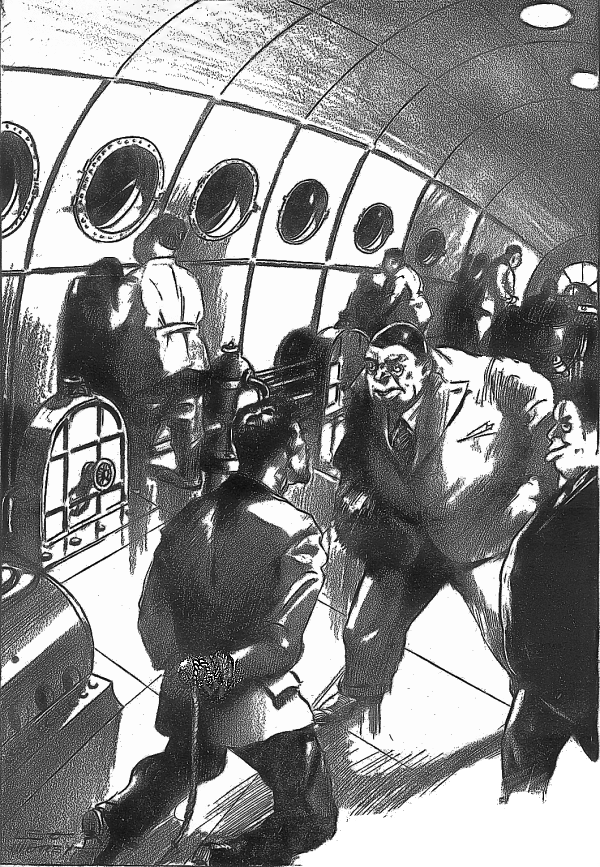
“What about those other tanks and nozzles?” I asked, pointing to the square tanks with their gun-mounted nozzles.
“Those,” Nebo explained, “are tanks of liquid so chemically compounded that almost any kind of non-metallic matter it touches bursts into flame. We use it by projecting it from those nozzles, and also have the small hand-rod containers of it.”
Light broke in upon me with his words. “Then that’s how you fired the laboratory-building of Dr. Winn, and Dr. Melford’s house and all the rest!” I exclaimed.
“Yes, we simply brought the flier, on a dark night, over the building we wanted to destroy. Hovering a little above it in the darkness, we had only to turn a few streams of the firing-liquid down on the building below and instantly it went up in flames.”
“And that’s how you did it!” I repeated. “I thought of an airplane, but an airplane couldn’t have hovered and would have been heard, so . . . Here I broke off.
I continued. “But why did you do it?” I demanded. “Why kill those dozen scientists and why carry me away?”
“Dr. Jackson, every one of those scientists we destroyed was working on experiments that might help to bring about interplanetary travel,” said Peter Nebo simply.
“We destroyed them, after they refused to stop their work, because we are utterly opposed to such travel taking place. We will never, while we can prevent it, permit the development of space-rockets or anything else that will allow men to journey to other planets.”
“But what’s your reason for being so dead set against men reaching other planets?” I exclaimed. “We thought you were madmen, with a delusion on the subject, but madmen couldn’t have designed this flier and these other things. You must have some reason.”
“We have a reason, Dr. Jackson,” answered Peter Nebo gravely. “And that reason is that we ourselves are from another planet and that our race is determined that men of Earth shall never invade our world.”
I stared at him. For a moment, my first reaction to his astounding statement was that after all these men were all mad. But the very craft in which I was being hurtled smoothly through the upper night, the very unfamiliarity of all the things about me, beat down this idea and supported, incredible as it was, Nebo’s assertion.
“I know that it will be hard for you to understand and believe,” Nebo was going on, “but it is quite true. I and all my companions are natives of the planet that you call Venus.”
“You mean to tell me, then, that you came to earth from Venus?” I said hoarsely. “In this flier?”
“Not in this flier,” Peter Nebo corrected. “This is but one of the craft we use on Venus and which we brought, with several others, for use here on earth.” “The ship that brought us here from our world is many times the size of this one and quite different, though it operates on the same principle of gas-firing recoil as this little flier.”
“It’s unbelievable!” I said unsteadily. “You can’t be from another world—you, men like myself!”
“We are not men like yourself, Dr. Jackson,” said Nebo quietly. “We are not men at all.”
“Look, and be assured for yourself,” he added, and turning, gave a brief command to one of the men guarding me.
At once the fellow reached up and to my surprise and horror jerked off his close black hair in one mass, a wig in fact, and disclosed a green-skinned soft head like that of a seal.
He quickly then doffed his clothing. I cannot express the horror that was mine, when I saw that his body also was green-skinned and seal-like, a soft boneless trunk from which branched arms and legs that were in effect huge feelers or tentacles like those of an octopus, instead of ordinary human limbs.
I saw then that the face and hands were white-painted, accounting for their unchanging dead-whiteness. I saw also that the only parts of this grotesque and unhuman body that looked human at all were the hands and fingers, the face with its nose and mouth and ears, and the eyes— the parts of the body covered by ordinary clothing being totally different from the human.
The thing reassumed its clothing at Nebo’s order. Shaken, sick, I stared at Nebo himself. “Then all of you are like—like that—” I struggled with the words.
“Yes, I am the same and so are all these others,” Peter Nebo answered.
“My God, creatures wholly inhuman!” I exclaimed.
“But creatures which, I think you will have to admit, equal and surpass you humans in intelligence,” Nebo told me calmly.
“But you passed as humans—you talk our languages—” I said, unable still to understand.
“We did, because it was necessary to fulfill our work here on your world,” he said.
“But what is your work? The killing of scientist’s here?”
“Our work,” Peter Nebo said gravely, “is the prevention of any scientific research on the part of you humans which might lead to your attaining power to visit our world.
“That is why we have killed the space-rocket inventors and other experimenters and that is why we have carried you off like this, Dr. Jackson. To understand fully our motive, you must understand something of our history.”
His voice was very serious and thoughtful, and as his pale green eyes looked calmly into mine and his deep voice talked, I could not realize that this was a non-human creature of another world.
AS he spoke, I sat half-crouching on the floor, listening with a terrible tenseness. The whirring of the firing tubes never stopped as the flier drove unceasingly northward through the upper night. Except for Nebo and my two guards, the others in the craft were on watch at either the controls or mechanisms.
“Our world, the world that you have named Venus,” said Peter Nebo (I could still think of him only by the human name), “is a world very much unlike yours in some respects. It is of much the same size as your earth and like it, has a day of about twenty-four earth-hours.
“Also, like Earth, Venus has an atmosphere with the vital substances of carbon dioxide and oxygen present in it, though in somewhat different proportions. But the surface of our world differs very much from the surface of this one.
“Venus has no moon. At first that fact may not seem important to you, but it has made a great difference between the two worlds. When earth was semi-molten, it flung off a great mass of its matter that became its moon. That caused irregularities of height in the surface of the earth, so that when its seas formed, they ran into the deeper basins and formed oceans, while the higher areas formed continents of dry land.
“On Venus, on the contrary, no moon having been flung forth, there have never been such irregularities of level. For that reason, when our seas condensed from the primeval hydrosphere of our planet, they covered almost the whole planet, a few small islands alone remaining uncovered. Thus, our world is predominantly a watery world.
“Because of that, evolution on Venus has followed a somewhat different course than on Earth. Here life originated in the seas and there developed its first crude forms. But very soon in its history, life moved to the land, where it began the development of a multiplicity of land-forms. After ages of such land-development, one class of the vertebrates, the mammals, proved most successful, and after still more ages of variation and selection, one species of those mammals, man, developed the real intelligence, which has made wonderful progress.
“But on Venus, the story of evolution was entirely different. There the great part of the history of life was enacted in the waters and only comparatively late in its history was the land invaded by any life. For there the land-masses were small and unpromising, and the seas were endless and bountiful. In our world, life had developed to a comparatively high level and had produced a species of creatures of some intelligence before any living thing ventured on the land. That species of which I speak was ancestral to my own species.
“Back in those times of our earliest development in the Venerian seas, there was little vertebrate development, conditions being different than those of your terrestrial seas. The chief development in so far as intelligence and activity were concerned was among a class of creatures akin to the cephalopods, the octopods and squid of Earth.
“These creatures were four-armed, capable of quick motion through the waters and had considerable enterprise and strength. They advanced rapidly in these things until they dominated the seas and outmastered all competing creatures. Their instincts widened into consciousness and intelligence, dim at first but slowly growing.
“They were water-breathing creatures, special organs in their bodies extracting the dissolved air from the waters, but they were able also to live for some time in the air and to breathe air. Their ability to breathe air soon enabled them to spend all their time on the land. They consciously desired to invade the land and gradually they did. It was a deliberate conquest of land much different from the instinctive invasion of land made long ago by your ancestral forms of life on earth.
“Once on land, the capabilities of these creatures rapidly expanded. They learned to walk on two of their tentacle-limbs and to use the other two as arms for manipulation purposes, carrying their heads or brain-cases erect above their bodies. They quickly learned the use of tools and built structures, dwellings—a progress that would have been impossible had they remained in the waters.
“Soon their numbers crowded the islands that were the only land of Venus, and their structures had so increased as to form cities. They had designed vehicles and mechanisms by then, and weapons, and their scientific knowledge grew continually as the scientific spirit took hold.
“Two thousand years ago, while humans were still mostly barbaric and knew nothing of science, our race had reached a fairly civilized state. We were slowly becoming conscious of the real scheme of the universe, of the admirability of truth. We were, and have been ever since, just a little ahead of you in scientific progress.
“Our speculations as to what lay outside the unchanging cloud-screen that is our planet’s sky, were unending. At last, eight hundred years ago, we developed an astronomical science which made it possible for us to look through the cloud-screen by using telescopic and photographic instruments sensitive to infra-red rays that can pass through the clouds.
“That is how we came to see the sun and the other worlds of the solar system and the stars. Gradually there arose a desire among us to visit the nearer of the other worlds. The planet nearer the sun than us, that you call Mercury, was plainly uninhabitable. But the next one, Earth, looked habitable to us and much we desired to visit it.
“So began experiments in space travel that continued for a long time. Innumerable projectiles and rockets were designed and launched, but none were successful. At last, two hundred years ago, a ship, designed on the rocket-recoil principle, proved workable. And when Venus and Earth were in inferior conjunction, that ship made its first successful trip.
“That first Venerian ship reached earth in what you would call the first part of the eighteenth century. But the Venerians, before landing openly on Earth, carefully reconnoitered its surface without themselves being seen, so that they might be sure there was no danger.
“It was well for Venus that they did so. For they saw that Earth held a race of intelligence and knowledge of science almost as great as the Venerians’, and a race whose millions far outnumbered ours. They saw that this race of man had devised the most destructive weapons of which their science was capable and that with these weapons they fought unceasingly among themselves, striving to subdue each other and slaying each other in hosts.
“This was enough to give the Venerian explorers pause. What would happen, they asked themselves, if they landed among these races of men and told them they came from Venus? Would these fierce, hostile hordes not see at once in Venus new lands to conquer? Would they not attempt to duplicate the Venerians’ ship and travel across the void to attack the Venerians?
“It might take them a long time to duplicate the Venerians’ feat of space-travel, but they could undoubtedly succeed eventually. Once they had knowledge of that other world, and the possibility of reaching it, these restless beings would not halt until they had done so. And would that contact between humans and Venerians not inevitably mean bloody combat?
“WITH these things in mind, the first Venerian explorers did not make their presence known to the men of earth. Instead they headed back to Venus, and the people of Earth never even suspected their visit. When they reached Venus, they made detailed report to the Venerian leaders of what they had seen.
“Their report was given much attention. It was finally decided that the Venerians should never let the men of earth know of their existence, for, though our science was greater than that of the humans, though we could no doubt repel them if they tried to attack us, yet there were thousands of them to every Venerian and it might mean unceasing attempts on their part to invade our world. No, we would never let them dream of our existence!
“It was recognized, though, that with increasing scientific ability, the humans of earth might before long try to devise space-ships of their own.
“If they did so, they would duplicate our feat and reach Venus. They would find our crowded Venerian cities on our little islands and would take news of them back to earth.
“We decided, therefore, that we must do all in our power to prevent the earth-peoples from ever developing a method of space-travel. To do this, we would have to keep some Venerians always on earth as spies or agents acting for us.
“Since such spies must look as much as possible like humans, to pass when necessary as such on earth, a group of Venerians were altered surgically to enhance a human resemblance. The tentacle-ends of their arms were made into human hands and fingers, the ends of their leg-tentacles were made capable of wearing human shoes; their faces were somewhat remodelled to approach the human; artificial teeth placed in their mouths and alterations of their vocal cords enabled them to produce the sounds of human speech; and wigs to simulate human hair were provided and their green faces and hands were whitened.
“This group then headed for Earth as passengers in one of the space-ships we had built. Their first care was to establish a base on earth where they would not be discovered by humans, and they did establish such a base in the uninhabited stretches of what you call Eastern Labrador. There they built shelters for themselves and the supplies they brought, building also a landing-frame-work for the greater safety of the space-ship. Then the space-ship returned to Venus, leaving the Venerian spies in their base.
“These Venerians had several of the small fliers we of Venus use for transport between our various islands. In these they ventured out, flying always by night, and explored Earth. They found parts of it still very savage and other parts civilized. They captured humans and took them back to their base, forcing them to teach them the various earth-languages. Of course when they had learned all they could from these captives, they were forced to kill them, although we Venerians abhor bloodshed ordinarily, still we could not let a few lives weigh against the good of an entire race.
“These Venerian spies kept their watch over Earth. They procured and read its journals and newspapers and made sure that no attempts at space-travel were being considered by humans.
“In a few years Venus and earth were again fairly close to each other in space and across from Venus to this world came a Venerian space-ship with relief for our spies—other Venerians, who would take their place.
“When these new arrivals had received sufficient information and training, the others, or the greater part of them, went back to Venus in the ship. And the new arrivals continued the watch upon mankind.
“And so it has been in all of the two hundred years that have passed since then. Unsuspected by all of you humans, there has always been a group of Venerians in our base, who, disguised as humans, were able to keep posted on the progress of human science.
“Every few years they were replaced by others from Venus who volunteered for this duty.
“In all this time, until about twenty years ago, there was little work for our spies. Although he has progressed rapidly in scientific knowledge, man has been concentrating upon extending his power on earth without thinking of leaving it. He has devised railroads and steamships, electrical power and radio and airplanes, but he has almost ignored the possibility of visiting other planets.
“But about a quarter of a century ago, our spies brought back to Venus word that men were beginning to speculate on the possibility of interplanetary travel. It was little more than speculation, romancing, but it was significant of what might come. So our spies on earth were ordered to prevent at all costs any real development in space-travel research.
“The first case in which our Venerian spies took action occurred eight years ago. Until that time, there was only empty speculation about space travel, and not much of that, but eight years ago, our spies learned that Willem van Hijnn, a Dutch engineer, had become convinced that a space-rocket could be designed, which would reach other planets, and he was working on designs.
“Our Venerian spies, with their superior knowledge of science, knew van Hijnn’s rocket-designs to be unworkable, but nevertheless his researches on the subject could not be allowed to proceed. So, not wanting ever to take life, save when there was no other course, they visited van Hijnn in disguise and warned him to stop his work. He refused, never dreaming, of course, of their true identity.
“So our spies were forced to kill van Hijnn and to destroy his work. They did so quite simply by bringing their flier over his laboratory by night and turning on the building a stream of our chemical fire-fluid, which causes any non-metallic combustible substance it touches to burst into flame. Van Hijnn and his work were destroyed.
“In the same way the others were warned. Each one refused to heed the warning. They were all destroyed. Morrow, and Krasney, and the two Japanese, these space-rocket experimenters perished in the next few years in the same way as had van Hijnn and for the same reason.
“THREE years ago, when the relief-ship came from Venus, I came with it to earth, to take my place as head of the Venerian spies here. You seem to think that it was I who was responsible for the killing of van Hijnn and those other earlier experimenters, but that is only because we Venerians all look alike to you in this disguise. I was never on Earth until three years ago.
“In these three years, I have done my part for Venus. Dr. Hayes, the Australian rocket-worker, was the first scientist I had to destroy. Then Wilsoff, and Molokoff, then Dr. Braun and Mertaud, and finally Dr. Melford and Dr. Winn. For the sake of my race, my world, I have led in the destruction of these scientists who might have brought nearer interplanetary travel for men. It is now almost time for the relief-ship to arrive and take me and my companions back to Venus, but others will arrive to take our place. As long as we have spies on Earth, no progress toward space-travel will ever be made by men!”
As Peter Nebo’s serious, quiet voice stopped, I stared into the Venerian’s calm green eyes with my brain whirling.
During all this conversation, the flier continued to whirr on softly at tremendous speed, northward through the night. The other Venerians remained on watch at controls and mechanisms, but so fascinated had I been by what I had heard that I was unconscious of my surroundings.
One paramount question burst up from the chaos of my thoughts.
“But if you warned and then killed all those space-rocket experimenters to prevent the furtherance of interplanetary travel, why didn’t you kill me?” I asked. “Why did you carry me away?”
“Those other scientists,” Nebo explained, “were all experimenting with space-rockets and fuels which, while they might in time bring about space-travel, were far inferior to our own design of space-ships. We destroyed them simply to prevent men from progressing in any way toward space-travel, as I have already said.
“But you, Dr. Jackson, in discovering a method of producing unlimited atomic power, have gone further than our Venerian scientists. Often have our scientists tried to produce atomic power and failed. When we learned that you had solved the secret, we had no desire to kill you and destroy your work. We wanted, instead, to take this secret of yours to our scientists.”
“You mean that you carried me away because you want to get my secret of atomic power from me?” I cried. Peter Nebo answered in the affirmative.
“Yes, for by so doing, we advance our own scientific powers and space-travel possibilities immensely. At the same time, we prevent your secret from ever becoming known to humans.”
I stared at him and then I began to laugh—raggedly, weakly, hysterically. Nebo stared at me and the other Venerians in the speeding flier to gaze at me too.
“The joke is on you in that case, Nebo!” I cried. “There is no secret of atomic power—I never discovered it at all!”
“That cannot be so, Dr. Jackson,” Nebo said calmly. “In the newspapers of the last few days there have been long accounts of your discovery of atomic power and your intention to use it in a space-traveling rocket.”
“But those accounts were lies!” I shouted. “They were concocted deliberately by young Melford and Crail and von Gersten and me and published to draw you and your band to me so that we could trap you!”
Nebo’s expression did not change. “I quite understand why you should say so,” he told me. “Naturally you do not want this secret of atomic power to fall into the hands of another race, another world.”
“But I’m telling you the truth!” I said desperately. “The whole thing was merely published to lay a trap for you and your associates. That’s why my friends were at hand when you appeared!”
“Your friends would naturally be guarding you when you had such a secret,” the Venerian remarked. “I am afraid there is no use pretending that you do not have it.”
I stared helplessly at him. “You’ll find out otherwise when you try to get such a secret out of me,” I told him.
“I will not try at all,” he answered. “I will leave that to the scientists of Venus.”
A cold sweat seemed suddenly to break out on my forehead. “Of Venus?” I repeated. “Do you mean you’re going to take me . . . .”
“You will be taken to Venus, yes,” he said. “The Venerian relief-ship will arrive at our base in the next two days and when it returns with us to Venus, you go too.
“Once on Venus, our scientists can no doubt extract from you information regarding your method of producing atomic power. You will not be harmed unless you make it necessary, and, though you will, of course, never see earth again, your experience may not be unpleasant.” The prospect opened by his words was so appalling, that for a moment I was left speechless. A random thought struck me.
“They’ll know—my friends will know you’re from some other world when they find and examine the body of the Venerian shot in the laboratory!” I exclaimed.
“No, for two of my followers fired the laboratory as we left,” Nebo said. “That will destroy any formulae as to your discovery that you may have left, and will also destroy the body of our companion.”
I did not know, could not know at that time, that two of Crad&rsauo;s men had managed to bring that fire under control, any more than the Venerians suspected it. I felt caught in some nightmare, from which presently I surely must wake.
Nebo left me and went to the nose of the flier again. I saw him conferring with the two Venerians at its controls, no doubt on the course being followed.
I remained in a sort of dream as the flier whirred on through the night. The events that had snatched me from my New York laboratory and presently would transport me across a great gulf of space to another world seemed incredible, impossible.
Looking now and again from the window, I could see only darkness beneath, and from this absence of lights I judged that the flier was already hurtling over the sparsely-inhabited wastes of northern Quebec toward Eastern Labrador. Also, the stars were paling eastward to announce the imminence of dawn.
When the sickly gray light of day began to appear in the east, it dimly disclosed a barren, treeless, gray plain far below. Over these steppes that were wholly without sign of human beings, the flier was moving at dizzying speed.
But even as the day grew, the flier was beginning to slacken speed and to decrease its altitude. I saw Nebo and the other Venerians gazing from the windows ahead and guessed that we were nearing their base.
There came into sight on the gray plain ahead what looked like a small circle. As the flier rushed on and down toward it, I saw that it was a circular embankment of earth, perhaps fifty feet high and a thousand in diameter.
Inside it, was a row of neat metal buildings of no great size, except for three or four that looked like storehouses.
This row of buildings was at one side of the circle and at the other was a huge and curious structure. It was a metal framework built up from massive girders, something like an amphitheatre or hollow hemisphere in shape, as though made to receive a huge ball. It was at least two hundred feet across.
The flier headed down toward the row of buildings. I saw two other fliers resting on the ground beside the houses, and a number of figures running out of the buildings as we descended.
Our craft slanted down, hovered motionless a few yards over the ground whirring softly, then sank vertically until it rested on the earth. At once one of the Venerians threw open the door, and a wave of cooler air poured in.
Nebo spoke to my two Venerian guards and then to me. “Please go with us without making trouble, Dr. Jackson. It will be better for you if you do.”
“WHERE are you going to take me?” I asked.
“Just to one of the buildings where we must confine you until the relief-ship comes,” he said.
“All right, then,” I answered, after a moment’s hesitation.
I stepped out of the flier to the ground. Around me, besides Nebo and my two guards, crowded a score or more of figures.
They were Venerians like those I had already seen, disguised like Nebo and the others by human-clothing, whitened hands and faces and the black wigs. I could not tell one from another—they looked so much the same.
Nebo and the guards led me toward one of the smaller metal buildings. I noticed that the guards kept their rods ready for use at all times.
The door was opened and I stepped into the little building. It was about twelve feet square and had no windows—being used formerly as a minor store-room by the Venerians, I supposed.
“Food will be brought you shortly, Dr. Jackson,” Nebo told me before the door was closed. “We have no food such as you humans consume, but I think you can shift with ours.”
“When, exactly, do you expect your ship from Venus to come?” I asked him.
“It should be here day after tomorrow if all has been well with it,” he said. “You will know as soon as it arrives, for always it stays just long enough to disembark the Venerians it brings and take on those returning to Venus. It does not stay longer, lest there should be some chance discovery by humans of its coming.”
“But you can’t really expect to take me back on it?” I exclaimed. “Not to another world, when I’ve told you that I have no process of producing the atomic power?”
The Venerian’s strange face was expressionless. “I have no choice in the matter,” he said. “I have my duty to my race and my world.”
With that, he left me. I inspected the interior of my prison for some time in the hope that there might be some method of escape from it, but soon found there was none.
Within a half-hour the door opened and I was handed a shallow metal platter of dark red mushy substance, and a metal bottle or flask of liquid, which proved to be pure water. I ate a little of the mushy Venerian food but found a certain repellent fishy quality in its taste and gave it up. Certainly, I told myself, if that were to be my food in the future, I would be poorly off.
When the food was handed in, I saw two of the Venerians standing guard at the door with the fire-fluid rods. It was quite evident that Nebo was taking no chance of my escape before the ship from Venus came.
And when it came—what then? I asked myself. A voyage in it as a prisoner to another world, a captivity without hope of release in the island-cities of the watery world of Venus?
Captivity—and maybe torture or death! For it was evident that Nebo and the other Venerians fully believed my published statements and were convinced that I had in my possession the knowledge of a method to produce limitless atomic power.
Once on Venus, their scientists would certainly endeavor by all means to wring that supposed secret from me. The murders of space-rocket experimenters, which they had systematically committed on earth to prevent humans attaining interplanetary travel, proved that they would not balk at extreme measures to make me tell them the secret.
I had no secret to tell them, but they would never believe that. They might use the most refined scientific tortures to make me talk. I cursed the inspiration of Captain Crail that was responsible for my issuing those statements. Crail and von Gersten and Artie Melford, would they or anyone ever know what had happened to me?
Gradually I became aware that I was very tired, and stretching out on the floor of my prison, I slept. When I awoke it was with a sensation of cold, and through the door-cracks I now saw that it was night outside. I had slept through twenty-four hours or more in my weariness.
The next hours passed without incident. I was brought more of the food in the morning, and this time I ate more, for I was extremely hungry. I looked for Nebo to appear again but he did not. With the food this time, though, was brought a sleeping-rug.
I heard Venerians pass outside now and then and once the whirr of a flier that went and returned in a few minutes. I slept fitfully, my dreams dominated by my knowledge that the next twenty-four hours were to be my last on earth if the relief-ship came as expected.
When I woke again and my food was brought, Nebo came too, eyeing me thoughtfully.
“No, we have seen no sign yet of the ship,” he said in answer to my first question. “But it should be here sometime soon.
“When it does come, and we take you to put you aboard it with us, I warn you not to make any struggle or effort to escape.”
It had been my resolve to make a last-minute attempt to break free, but I did not say so. “Why not?” I asked.
“Because in that case we will have to use force,” Nebo answered. “We will take no chance of killing you, of course, but rather than let you delay us, we will stun you. You will avoid this unpleasant experience by being reasonable.”
I said nothing and he went out. I heard him speak to the Venerians guarding my door as he closed it.
In indescribable tenseness I sat waiting for the inevitable moment. Hour after hour passed, morning gave way to noon, and noon to afternoon. By sunset I began to wonder if the ship would come at all.
Almost as I wondered I heard a throaty cry from one of the Venerians outside, repeated instantly by a score of them. I sprang to my feet, trembling. I seemed to hear a faint sound like distant, steady throbbing.
I could hear the Venerians running about outside my prison. Suddenly the door was flung open and Nebo appeared, four armed Venerians with him.
“The ship is arriving!” he told me hastily. “Remember my warning, Dr. Jackson. Come with us quietly.”
I stepped out with them into the sunlight, trembling despite myself. The sunset westward threw brilliant light over the enclosure, and the Venerians were running toward the great metal framework at its other side.
Nebo pointed obliquely upward. There, high in the light-streaming heavens, hung a little ball of light dropping rapidly on a steep slant toward the enclosure. And as I saw it, I became aware of a faint, throbbing sound that was rapidly growing louder.
“Quick!” cried Nebo. “We must be at the framework when it lands!”
With him and the Venerian guards close about me, and the other Venerians running nearby, I was hustled across the enclosure.
Looking up, as I stumbled on with my captors, I saw that the little light-ball was a metal sphere, a huge globular craft, gleaming in the sunset’s light, as it sank with slackening speed toward the framework. The throbbing of it was now a loud and continuous thunder in our ears.
IT CAME lower, more and more slowly, a colossal two-hundred foot metal ball sinking toward the framework built to receive it. I was half-way across the enclosure now with Nebo and the other Venerians. Then, as a new sound smote my ears over the thunder of the descending Venerian ship, I looked up.
I yelled, and from Nebo and the Venerians came cries of amazement and alarm. The new sound I had heard was a staccato roar and as it came to a crescendo, I saw an airplane speeding over the enclosure from the east! Behind it were three more and behind those a half-dozen others, roaring at top speed toward the Venerian ship that even now was settling into the framework!
The planes dived and from them came the rattle of their guns speaking over their motors’ roar, pouring a leaden hail down on the framework and ship in it! I saw Venerians by the framework fall, saw a door in the great globular ship’s curving side swing open and Venerians emerge, pointing up at the planes and shouting.
Nebo forgot me for the moment, cried orders rapidly to the Venerians at the buildings. They ran to the four torpedo-like fliers, and in a moment these soared up toward the planes.
The Venerians holding me sought again to drag me toward the framework and ship, but now I was struggling, fighting with fists and feet.
And as I fought, I saw the airplanes and the Venerian fliers above engaging in a wild dog-fight. Two of the fliers crashed at the same moment against a plane and all three fell.
From the remaining two fliers sprang jets of clear liquid and in quick succession two planes burst into flames and spun downward. But there followed one of the fliers and then the other as remaining planes poured a storm of lead upon them and through their windows and into them.
There was a chorus of yells from the edge of the enclosure and on its eastern and southern embankments appeared troops of men, brown-uniformed soldiers with rifles, running down into the enclosure and firing at the Venerians and the framework holding the ship.
At this, the Venerians left in the enclosure ran toward the framework. I saw them swarming up a metal stairway toward the open door of the huge ship. Nebo and my guards were dragging me despite my struggles toward the mighty framework.
Abruptly three of my guards dropped around me and at the same moment I felt something like a hot iron sear my shoulder. I wrenched free from Nebo and the other guard and stumbled away from them, as more rifle-bullets hummed past us.
Nebo and the Venerian ran after me and then suddenly they too collapsed and lay still. There was no Venerian left living in the enclosure save those clambering into the great ship. And as I dropped to my knees, I saw the last of them hasten into it, saw the great door ponderously close, and then with a sudden terrific, throbbing thunder, whose detonations almost split the ears, the huge ball rose into the air from the framework.
Slowly, majestically, at first, but faster and faster, the mighty sphere rose into the sunset, unheedful of the comparatively tiny airplanes that dashed and stung about it—rose until it was far overhead, a dwindling light-globe.
Soldiers dashed past me toward the framework and then arms caught and pulled me to my feet. Men in civilian clothes were about me, all crying out together.
“Lloyd!” shouted one of them, and I came out of my daze to recognize Arthur Melford’s excited face, and then beside him was Captain Crail, his features taut, and von Gersten with blue eyes flaming with excitement.
“Lloyd, we got here in time!” Arthur was almost weeping. “By heaven, they were taking you to that ship . . . .”
“To Venus, yes,” I said. “But how did you know that you should come here? How did you learn where their base was?”
“The one I shot!” Crail cried. “We found a metal world-map in his pocket with lines drawn on it all radiating from one point in Eastern Labrador. And von Gersten ... .”
“Von Gersten,” the German finished for him, “sees that that point in Eastern Laborador can be but their base, where they come forth from on their trips over earth. We get the soldiers and the planes and hurry to this point, in time to save you, though their ship gets away, it seems. And you say, to Venus!”
“Yes, Venus!” I exclaimed. “Look, can you see it up there—can you see it yet?”
High in the brilliant western sky the globular ship was now but a little ball of light, diminishing steadily as it rose on a steep slant. Up and up it went, smaller and smaller it became in appearance. And below it we could see another speck of light, but one that was sinking after the sun, the planet Venus dropping from our sight.
Then as we stared in awe, von Gersten and Crail and Arthur and I close together, we saw the receding light-ball become a mere pinhead of luminescence, a tiny shining point. It seemed to waver for a moment in our vision, to hesitate. Then it was gone and we stood staring after it into the empty sunset sky.
THERE is nothing which I, von Gersten, can add to the known facts of that most astounding series of killings, which has come to be called “the space-rocket murders” and its even more astounding sequel and explanation. The accounts drawn up by my companions and friends of their various experiences in this so-strange adventure summarize those facts completely.
Yet, if the facts need no addition from me, it may yet be that some comment would not be amiss. So, at least, have Mr. Melford and Captain Crail and Dr. Jackson told me, asking me to attach to their documents my opinions as to the questions which must necessarily arise.
We men of earth have for the first time come into direct contact with beings of another world, who were at least as intelligent as we are. In the Venerians’ view of us, as told to Dr. Jackson by Nebo, we humans who rule earth so unquestioningly, for the first time see ourselves as others see us. And what we see is not pretty!
No! We see that to beings with even a little more civilization than ourselves, such as the Venerians, the races of men appear a fierce, hostile and cruel species—a species that utilizes its best intelligence and greatest powers for the conducting of internecine war between its own divisions, an untrustworthy, combative and merciless race to be feared and watched as the Venerians feared and watched us.
To us self-styled civilized races, this view comes as a shock. Is it justified? we must ask ourselves. Were the Venerians wise to distrust us to such an extent as to use any means to prevent us from ever reaching their world? Or have the Venerians been misled by surface aspects and taken precautions which they might have spared themselves?
I think that any reflecting person, who looks without bias at our world and what we have made of it, must agree that the Venerians showed wisdom in the course they took. For let us suppose that when the Venerians first visited earth two hundred years ago, they had made themselves known to the people of earth and had helped them build space-ships like their own. Suppose they had done that fifty years ago—five years ago. What would have been the result?
Would there not have been space-ships sailing from earth to Venus soon, crowded with the curious, the self-seeking, the restless? And when they reached Venus, if they found there anything considered of value by men, gold, precious stones, valuable minerals, who can doubt but that soon more and more ships would have been sailing Venus-ward, that the Venerians’ natural resources would have been ruthlessly exploited, and that when the Venerians resisted, they would have been fought and in time wiped out just as here in our own world the Tasmanians and the Red Indians and a score of other lower races were annihilated?
No, much as we may dislike to admit it, we must confess that the Venerians acted for their own best interests when they deliberately planted spies on earth to retard and prevent entirely, if possible, the development of space-travel by men. And, from their point of view, the few deaths their course occasioned here on earth would be well justified by the prevention of the disastrous consequences if man ever did reach Venus.
But this lies in the past. We know now that the Venerians exist and that they have developed a method of space-sailing. We are aware even of the fact that their numbers are less than ours, though their science is farther advanced. Their two hundred years of watch on us, through their spies on earth, has been disclosed to us.
Parenthetically, there is small chance, to my mind, that the Venerians will attempt to resume this watch on us. I doubt if they will ever again seek to maintain spies on earth, not only because, since they have been once discovered, their work would be almost impossible, but also because the object of their watch is gone, now that we know all these things and are fully aware that Venus is a habitable and inhabited world.
No, this first secret phase in the relations of Venus and Earth, the one planet’s race being entirely unaware of the other’s existence, is gone forever. The great question now is, what are the two worlds’ relations to be in the future?
It is evident, that if the Venerians have developed space-ships, we also can do so, though perhaps much time must elapse first. But as the scientific knowledge and power of man marches steadily onward, the day must surely come when man, too, will take to space and sail to other worlds. When he sails to Venus, will it be as an invader or a friend?
The Venerians, no doubt, believe that he will come combatively, and probably from now on will be busily preparing weapons with which to resist the hordes of earth that will someday drop out of the sky. Many there will be on earth, too, who will want to see man go as a conqueror, who will vision an empire of humans extending from end to end of the solar system, from Mercury to Pluto.
It may be that their visions will be fulfilled and that the Venerians will go down under a human invasion after long resistance, and their little islands will be peopled by human colonists. It may be that less-developed races on other planets will be exterminated also to the greater glory of humanity. Certainly there will be many in that future day who would thrill to the trumpet-call challenge to bring every planet in our system under the domination of man.
But there is a chance, also, that when man does visit Venus and the other worlds, it will not be as a conqueror but as a friend. There is a chance that by that time man will have outgrown his barbaric war-fever that still racks earth and will have seen it for the childish thing it is, unworthy of a mature race. And that chance increases each day, for each day sees us a little farther, a tiny little, away from the glory in war for war’s sake, that formerly was ours.
So the fears of the Venerians may prove vain after all. So the future may bring, not a cruel autocracy of man in the solar system, but a friendly, peaceful association of the solar system’s living worlds, with humans, Venerians and whatever other races the system may prove to hold, engaged in trade and travel from world to world.
May this prove indeed to be what the future holds! Our solar system, that seems now so vast to us, is in reality but a little, heated, lighted shelter in the cold black immensities of space.
May we different ones who inhabit it refrain always from fighting each other, and dwell in it in enduring peace.